| Products : Heat Exchangers Division |
|
In this division we manufacture :
- Finned Tubes for Heat Exchangers (FTHE).
- Air Cooled Finned Tube Heat Exchangers (ACFTHE).
- Shell and Tube Heat Exchangers. |
|
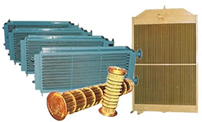
| Washer Finned Tubes : Individual washers are soldered over the tube surface. The configuration may include one or two tubes for low and high temperature application. |
| Strip Wound Finned Tubes : Controlled deformation of the strip under tension gives required contact pressure of the foot on the base tube for optimum heat transfer performance. Maximum operating temperature is 150 ° C. |
| "G" Fin (or Embedded finned Tubes) : The strip is wound into a machined groove and securely locked in place by back filling with base tube material. This ensures maximum heat transfer. Maximum operating temperature is 450°C in different material combinations. |
 |
|
Finned Tubes for Heat Exchangers |
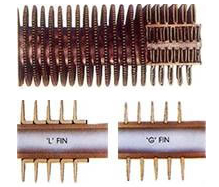 |
| Integral Finned Tubes : For making integral finned tubes seamless plain tubes are used as base material. The fins are produced by rolling them out of the plain tube wall. Thus the tube and fins are in one integral piece. The height of the fin may be low, medium and high. It can make in bimetallic finned tubes where outer finned tubes is made in Aluminium and inner liner material is copper brass S.S., M.S., etc. |
|
| Wire Wound Finned Tube with External Finning : This is one of the most efficient and successful design pioneered by famous Clayton Still Tube of U. K. |
| These are produced on automatic machines. In this design continuous series of wire loops are produced which are helically wound on to a tube and held in position with a binding wire before being automatically soft soldered to the tube surface. |
| Wire Wound Finned Tubes with External Finning and Bonded Wire Wound Internal Turbulator : When the fluid flowing through the material is oil or compressed air, a turbulator is needed inside the tube. The turbulator is wire wound on a rod and inserted inside the tube & bonded with inside surface of tube. |
|
| |
|
 |
| Available range : |
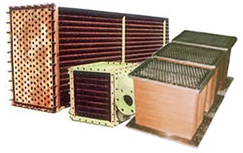
(a) ACFTHE using tubes with external finning
1) Radiators
2) Water Cooled Inter Coolers and After Coolers for cooling of air / gas. In these coolers water flows through plain bore of the tubes and air or gas flows over external finning of the tubes. Such air cooler are also used in large electric machines and are known as CACW heat exchangers. |
(b) ACFTHE using tubes with external finning and
internal turbulator
1) Air Cooled Oil Cooler : Oil flows inside the tube having a turbulator and air flows over external finning of the tube. |
| 2) Air Cooled Inter Coolers & After Coolers : The compressed air or gas to be cooled flows inside the tube having a turbulator and air flow over external finning of the tube. |
| (c) ACFTHE using tubes with internal turbulator and no external finning |
| Water Cooled Oil Coolers: The tubes have only internal turbulator and no external finning. Oil flows inside the tubes having turbulator and water flows over plain outside surface. |
|
Air Cooled finned Tube Heat Exchanger
|
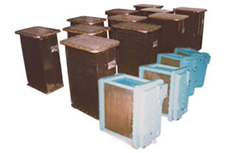
| Air cooled finned tube heat exchangers find a very wide use in industry as jacket water cooler for D.G. Sets, air cooler for large electric motors and generators, steam air heaters, oil coolers, refrigeration and air conditioning applications, etc. Major industries using finned tube heat exchangers are automobile, compressor, electric motor and generator, cement, textile, petrochemical and heavy construction equipment. |
| |
| |
| |
| |
| |
 |
|
|
| |
|
- Jacket Water Coolers
- Oil Coolers
- Oil Heaters
- After Coolers
- Inter Coolers
- Chillers
- Condensers
- Evaporators
|
| For application in Chemical, Petrochemical, Fertilizer, Steel, Cement, Power Plants, Refrigeration, Textile, Pharmaceutical, Nuclear Plants, etc.Type of Shell and Tube Heat Exchangers |
(a) Fixed tube plate type
(b) "U" tube type
(c) Internal floating head (Pull through type)
(d) Floating head external packed type, etc. |
Codes Followed:
: TEMA, R, C and B
: ASME Section viii, Div. 1
: BS, DIN, IS
We can also make shell and tube heat exchangers as per customers drawings / specifications or sample. |
|
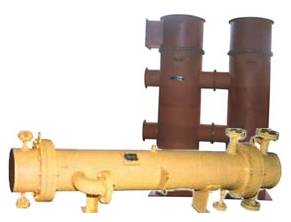
Shell Tube & Heat Exchangers
|
| |
| |
| |
| |
 |
| |
| |
| |
| |
|
4. RECUPERATORS
In cupola and other furnaces the exhaust gases leave at a high temperature of 900°C. This result is substantial heat loss causing high fuel consumption. If this heat could be recovered in some way and utilised back, the fuel consumption in cupola or furnace can be reduced.
The heat recovery is done by using the cupola / furnace exhaust gases to preheat the cold blast air. The equipment used for this purpose is known as recuperative heat transfer equipment (recuperator). |
| |
 |
|
| |
|
|
Tube Bundle
|
 |
| |
|
|
| |
[ Radiator Division ] |
| |